Maintaining Classroom Discipline in Primary School is made easier with expert tips, practical strategies, and key classroom management methods for future primary educators.
Welcome to this helpful guide on Maintaining Classroom Discipline in Primary School. Here, you will find useful and practical Tips for Successful Classroom Discipline and Management that truly work in real classrooms. We also share effective Classroom Discipline Strategies for Primary School Teachers to create a safe, engaging, and respectful learning space.
Whether you are already teaching or preparing to become a primary educator, this page provides Key Methods of Maintaining Classroom Discipline for Future Primary Educators in a simple and clear way. Explore this guide to build confidence, reduce disruptions, and help your students thrive every day.
Table of Contents
ToggleMaintaining Classroom Discipline
Maintaining classroom discipline in primary school is one of the most essential responsibilities of a teacher. A disciplined classroom does not merely mean silence or strict rules; it signifies an organised, respectful, and safe learning environment where students feel emotionally secure, socially connected, and academically motivated. Primary children are at a crucial stage of development, where good habits, emotional regulation, and cooperation skills need to be cultivated. This makes the teacher’s role not only instructional but also nurturing and guiding. Through effective classroom management techniques, the teacher creates a space where learning is meaningful, and every student can succeed.
Importance of Classroom Discipline
Classroom discipline is a key pillar for successful teaching-learning processes. When discipline is maintained:
- Learning time increases as distractions and behavioural issues reduce.
- Students become more responsible for their actions.
- The teacher can pay attention to academic needs instead of constant behaviour corrections.
- A positive class culture develops with value, respect, trust, and cooperation.
- Students learn essential life skills like punctuality, teamwork, self-control, and problem-solving.
Thus, discipline contributes to both academic growth and the holistic development of children.
Principles of Effective Classroom Discipline
Effective discipline doesn’t rely on punishment; rather, it is based on:
- Clear rules & expectations: Rules must be simple, age-appropriate, and clearly communicated. When children know what is expected and why those rules are important, they are more willing to follow them.
- Same Rules and consequences: Discipline must be fair and uniform for every student. Consistency builds value, trust and prevents confusion, favouritism, or power struggles. Every child must feel valued. Discipline must avoid favoritism, shaming, or bias toward any student based on ability, behavior history, or background.
- Positive reinforcement: Acknowledging and rewarding good behaviour encourages students to repeat it. Praise, stickers, and recognition are powerful motivators for young learners.
- Student involvement: Boredom leads to disruptions. Interactive lessons, group activities, games, and hands-on learning keep students focused and disciplined on their side.
- Good Teacher-Student Relationship: Children respond better to educators who show kindness, patience, and interest in their feelings. A strong bond naturally reduces misbehaviour.
- Opportunities for Responsibility: Assigning classroom duties such as line leader or board cleaner builds leadership, responsibility, and self-discipline in young children
- Teacher as a Role Model: Children imitate what they see. A teacher who displays punctuality, calm communication, and respect teaches discipline by example.
Emotional Guidance and Empathy: Teachers should understand the emotional needs behind behaviours. Helping students express feelings appropriately prevents frustration and conflict.
Effective discipline in primary school is not about punishment; it is about guiding children toward positive behaviour, self-control, and cooperation. By applying these principles thoughtfully, teachers can maintain a happy, safe, and productive classroom environment where all learners feel confident and motivated to succeed.
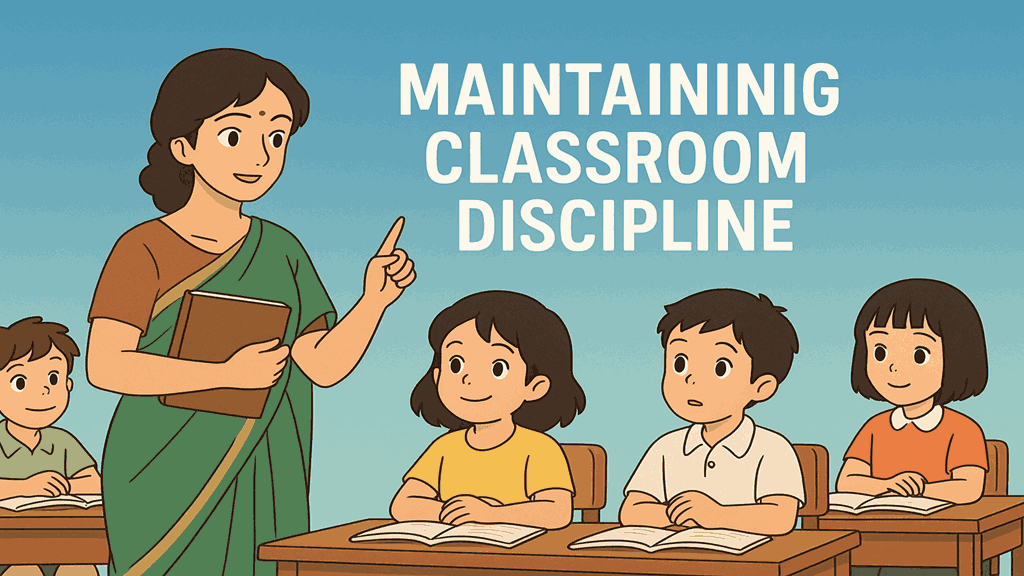
9 Key Strategies of Maintaining Classroom Discipline for Future Primary Educators
#1. Creating Classroom Rules Together
1. Creating Classroom Rules Together
Creating classroom rules collaboratively with students is a powerful and modern approach to discipline. When learners actively participate in deciding the norms of behaviour, they feel respected, responsible, and more willing to follow those rules. This shared ownership builds trust, encourages positive behaviour, and reduces conflicts in the classroom.
Why Creating Rules Together Makes Work:
- Increases Student Ownership: Students are more accountable because they helped create the rules.
- Encourages Respect and Cooperation: A democratic process builds mutual respect between the teacher and students.
- Promotes Understanding Instead of Compliance: Students understand the reason behind each rule.
- Improves Classroom Behaviour & Self-Discipline: Children monitor themselves and even remind peers politely.
- Boosts Classroom Harmony & Safety: Clear agreements reduce misunderstandings and disruptive actions.
Steps to Create Rules Together:
- Start with a Discussion: Talk about what makes a classroom safe, happy, and productive.
- Brainstorm with Students: Encourage them to suggest rules based on shared values.
- Simplify and Finalise Together: Combine related ideas into 5–7 short, positively stated rules.
- Agree and Display: Write rules on a poster; students sign to show commitment.
- Regular Reflection: Review rules during class meetings and revise if needed.
Example Collaborative Classroom Rules
| Rule | Purpose |
|---|---|
| We listen when others speak. | Builds respect and better communication |
| We take care of classroom materials. | Encourages responsibility |
| We raise our hands to share ideas. | Maintains order and fairness |
| We help and support each other. | Promotes teamwork and empathy |
| We keep our hands and feet to ourselves. | Ensures safety |
Teacher’s Role
- Facilitate discussion, not dictate rules
- Reinforce rules consistently and fairly
- Praise and reward positive behaviour
- Be a role model of discipline and kindness
Impact on Classroom Discipline
- Fewer behavioral issues
- Stronger teacher–student relationships
- Positive classroom climate
- Greater engagement in learning
#2. Establishing Daily Routines
2. Establishing Daily Routines
Daily routines are predictable patterns that guide students through classroom activities smoothly. When children know what to expect and what is expected from them, their behaviour becomes more organised, confident, and responsible. Effective routines help the teacher manage transitions, reduce confusion, and prevent disruptive behaviour.
Why Daily Routines Improve Discipline
- Provides Structure and Stability: Students feel secure when the day follows a familiar pattern.
- Reduces Misbehaviour: Clear expectations prevent disorder during transitions.
- Saves Instructional Time: Less time wasted on giving repeated instructions.
- Improves Self-regulation: Students learn to manage their behaviour independently.
- Supports Special Needs Learners: Predictability is helpful for children who struggle with change.
How to Establish Effective Routines
- Teach Each Routine Explicitly: Model the steps and demonstrate the correct behaviour.
- Practice Regularly: Repetition helps children remember without reminders.
- Give Positive Reinforcement: Praise or rewards when routines are followed well.
- Be Consistent: Apply routines every day, without exception.
- Adapt When Needed: If a routine doesn’t work, refine it with student input.
Teacher’s Role
- Be organised and disciplined in following routines.
- Maintain a calm and positive valued tone.
- Make routines enjoyable and easy to follow.
Impact on Classroom Discipline
- Smooth transitions between lessons
- Fewer disruptions and arguments
- Stronger focus and learning outcomes
- Confident, responsible students
- Peaceful and well-managed environment
#3. Positive Behavioral Reinforcement
3. Positive Behavioural Reinforcement
Positive Behavioural Reinforcement refers to encouraging desirable behaviours by recognising, rewarding, and praising them. In primary classrooms, young children respond more effectively to appreciation than punishment. When teachers acknowledge good behaviour, students feel motivated to repeat those actions, leading to a respectful and disciplined learning environment.
Why It Works in Primary Schools
- Enhances Motivation: Children put in more effort when their good actions are noticed.
- Builds Self-Esteem: Praise fosters confidence and emotional growth.
- Creates a Positive Climate: Focus on strengths rather than mistakes.
- Reduces Negative Behaviours: Good behaviour becomes the norm among peers.
- Strengthens Teacher-Student Relationships: Trust grows when students feel valued.
How Future Teachers Can Apply It Effectively
- Be Specific with Praise: Instead of just “Good job!”, describe the behaviour: → “Thank you for sharing your materials with your friend.”
- Reinforce Immediately: Quick recognition helps children connect behaviour with reward.
- Reward Effort, Not Only Results: Encourages continuous improvement.
- Keep it Fair and Consistent: All students should have equal chances to be acknowledged.
- Involve the Whole Class: Create a culture where students appreciate each other’s good behaviour.
Impact on Classroom Discipline
- Increased student engagement
- Lower behavioural problems
- Respectful interactions among peers
- Strong habits of self-discipline
- A joyful, supportive learning atmosphere
Positive reinforcement is not just a technique; it is a mindset. By celebrating good behaviour, future teachers become role models of empathy, leadership, and encouragement. With consistent reinforcement, primary students learn discipline not out of fear, but out of pride and responsibility.
#4. Building Warm Teacher–Student Relationships
4. Building Warm Teacher-Student Relationships
A warm and positive relationship between the teacher and students is the foundation of successful classroom discipline. When children feel valued, understood, and respected, they naturally respond with cooperation, good behaviour, and active participation. Primary students especially need emotional security and trust to learn and behave responsibly.
Why Warm Relationships Improve Discipline
- Trust Reduces Misbehaviour: Students listen more to teachers they feel connected with.
- Enhanced Emotional Safety: Children feel comfortable asking questions and seeking help
- Boosts Attendance & Engagement: Students are excited to come to school and learn.
- Promotes Self-Discipline: Students behave well to maintain the bond and approval.
- Reduces Classroom Conflicts: Positive rapport encourages empathy and respect among peers.
Practical Ways Future Teachers Can Build Warm Relationships
- Learn Students’ Names & Interests: Show personal attention and make each child feel important.
- Show Empathy & Patience: Understand their feelings and respond kindly to mistakes.
- Offer Positive Communication Daily: Smile, greet warmly, listen actively, and give encouragement.
- Provide Fair & Respectful Guidance: Avoid shouting-explain rules calmly and consistently.
- Celebrate Small Successes: Display their work, appreciate honest effort, and build confidence.
- Be Accessible & Approachable: Students should feel safe to share concerns and ideas.
Impact on Future Teachers’ Professional Growth
- Strong classroom management skills
- Better understanding of child behaviour
- Positive school–home partnership
- Higher student achievement and well-being
“Discipline grows faster in a classroom where children feel loved, not feared.”
Warm relationships are not a reward; they are the starting point of discipline.
#5. Active Engagement in Learning
5. Active Engagement in Learning
Active engagement means that students participate directly in learning through interesting, hands-on, and student-centred activities. When primary learners are busy exploring, discussing, creating, and solving problems, they stay focused and behave positively. Engaged students have less time for distraction and more motivation to follow classroom expectations.
Why Engagement Improves Discipline
- Keeps Students Focused: Less chance for boredom and misbehavior.
- Boosts Motivation: Students become excited to participate in learning.
- Encourages Responsibility: Children take ownership of their work.
- Supports Social Skills: Collaboration builds respect and cooperation.
- Enhances Learning Outcomes: Better understanding leads to confidence and positive behaviour.
How Future Teachers Can Ensure Active Engagement
- Use Interactive Teaching Methods: Group activities, pair work, role play, educational games
- Apply Learning by Doing: Experiments, art-integrated tasks, real-life examples
- Ask Open-Ended Questions: Encourage critical thinking and curiosity
- Rotate Learning Activities: Short, varied tasks maintain interest and reduce restlessness
- Use Visuals & Technology: Smart boards, videos, flashcards, storytelling
- Provide Movement Breaks: Action songs, classroom exercises to release extra energy
Impact on Classroom Discipline
- Increased attention span
- Better completion of tasks
- Reduction in noise and misuse of time
- Development of self-control and teamwork
- A lively, disciplined, learner-friendly environment
“Children misbehave less when learning is meaningful and fun.”
Through active engagement, discipline becomes a natural result of interest, involvement, and joyful learning.
#6. Conflict Resolution and Problem-Solving Skills
Conflict Resolution and Problem-Solving Skills
Conflicts among primary children are natural. Teaching them how to resolve disagreements calmly and respectfully helps prevent fights, arguments, and disruptive behaviour. When students learn problem-solving skills, they become more responsible and contribute to a peaceful classroom environment. Future teachers must guide children to express their feelings, understand others, and find fair solutions.
Why It Supports Classroom Discipline
- Reduces Behavioural Issues: Students learn to manage anger and disagreements constructively.
- Improves Peer Relationships: Encourages empathy, respect, and cooperation.
- Promotes Self-Discipline: Children take responsibility for their actions.
- Strengthens Communication Skills: Students use words instead of physical aggression.
- Creates a Safe Learning Atmosphere: Fewer conflicts enable smoother teaching and learning.
How Future Teachers Can Implement This Strategy
- Model Calm and Respectful Behaviour: Children learn conflict resolution best by observing the teacher.
- Teach Steps for Solving Problems: Identify issue → share feelings → think of solutions → agree → reflect.
- Create a Conflict-Resolution Corner: A space to talk and solve small peer disputes peacefully.
- Use Role-Plays and Stories: Practice how to handle real-life disagreements.
- Praise Positive Conflict-Solving: Reinforce when children behave maturely and respectfully.
- Encourage Peer Mediation: Train helpers to assist classmates in resolving disputes.
Discipline Outcomes
- Fewer interruptions during learning time
- Calm, cooperative, and respectful students
- Positive classroom culture based on fairness
- Stronger emotional and social development
“Discipline is not avoiding conflict; it is learning how to solve it wisely.”
When teachers equip children with conflict-resolution skills, they build a self-managed discipline system where students solve problems independently and maintain harmony.
#7.Preventing Bullying and Promoting Respect
Preventing Bullying and Promoting Respect
Bullying disrupts learning, damages confidence, and creates fear among students. To maintain a disciplined and positive classroom, future teachers must actively prevent bullying and build a culture of respect. When children feel safe, accepted, and valued, they behave better and support one another—leading to a healthy learning environment.
Why It Is Important for Discipline
- Creates Emotional Safety: Students focus on learning rather than fear.
- Builds Trust: Respectful relationships reduce conflicts and misbehaviour.
- Encourages Positive Peer Behaviour: Children learn kindness and empathy.
- Protects Mental Health: Students develop confidence and a sense of belonging.
- Strengthens School Community: Harmony improves overall discipline practices
How Future Teachers Can Prevent Bullying
- Establish Clear Anti-Bullying Rules: Consistent zero-tolerance policy for physical, verbal, or online bullying.
- Teach Respect and Empathy: Use stories, discussions, and moral education activities.
- Encourage Inclusive Behaviour: Group rotation, buddy system, and ensure no child feels left out.
- Monitor High-Risk Areas: Playground, corridors, lunchroom—supervise actively.
- Respond Immediately to Incidents: Take complaints seriously, provide support to victims.
- Empower Bystanders: Teach students to report bullying and help peers responsibly.
Practical Activities for Primary Students
- Circle time for sharing feelings
- “Respect Wall” with kind messages
- Role play on dealing with bullying
- Peer appreciation cards
- Story sessions on friendship & diversity
“Discipline grows in classrooms where every child feels safe, respected, and valued.”
Preventing bullying is not just a rule— it is a daily responsibility that builds confident, caring, and responsible learners.
Thank you for reading our guide on Maintaining Classroom Discipline in Primary School. We hope the practical Tips for Successful Classroom Discipline and Management and helpful Classroom Discipline Strategies for Primary School Teachers support you in building a positive classroom environment. Visit our website regularly for fresh Key Methods of Maintaining Classroom Discipline for Future Primary Educators and updated teaching tools.
If you found this useful, please share it with your friends, colleagues, and other educators. For any help or questions, feel free to contact our team; we’re always happy to assist you!