Complete guide to West Bengal Government Important Schemes including education, women, youth, and welfare programs in easy language.
Akanksha Scheme (আকাঙ্কষা স্কিম)
- Introduced by: Housing Department, Government of West Bengal
- Target Group: State government employees who have not availed benefits of any other housing scheme
- Objective: To provide affordable residential flats (“own house”) to government employees on convenient and easy terms
The scheme has been launched initially as a pilot project in the New Town–Rajarhat–Kolkata area.
Anandadhara Scheme (আনন্দধারা স্কিম)
Anandadhara is a joint initiative of the Central and State Governments of West Bengal aimed at rural poverty reduction and livelihood promotion. It is the state version of the National Rural Livelihoods Mission (NRLM / DAY-NRLM).
Objectives and Targets
- Formation and strengthening of community institutions, especially Self Help Groups (SHGs) among rural poor households
- Women’s empowerment and enhancement of economic independence
- Provision of credit access, promotion of income-generating activities, skill training, and market linkages
- Expansion of financial inclusion by connecting SHGs with banks and other financial opportunities
Overall, Anandadhara focuses on building sustainable livelihoods through community-led institutions and inclusive financial systems in rural West Bengal.
Jal Dharo Jal Bharo (জল ধরো জল ভরো)
Jal Dharo Jal Bharo is a flagship water conservation initiative of the Government of West Bengal, launched in 2011–12. The programme focuses on rainwater harvesting, water storage, and the maintenance of surface and groundwater resources. It is implemented by the Water Resources Investigation & Development Department (WRI&DD) in convergence with the Panchayats & Rural Development (P&RD) Department and MGNREGA.
Objectives and Goals
- Promote rainwater harvesting, including rooftop rainwater collection
- Re-excavate and renovate tanks, ponds, reservoirs, canals, and channels whose storage capacity has reduced
- Arrest surface runoff by constructing check dams and related structures to conserve water
- Ensure year-round water availability for irrigation during dry seasons, livestock needs, and household use
- Enhance the use of water bodies for pisciculture, animal husbandry, and other income-generating activities
- Create public awareness, especially in rural areas, about water conservation and efficient use
Overall, the programme aims to build climate resilience, improve water security, and support sustainable rural livelihoods across West Bengal.
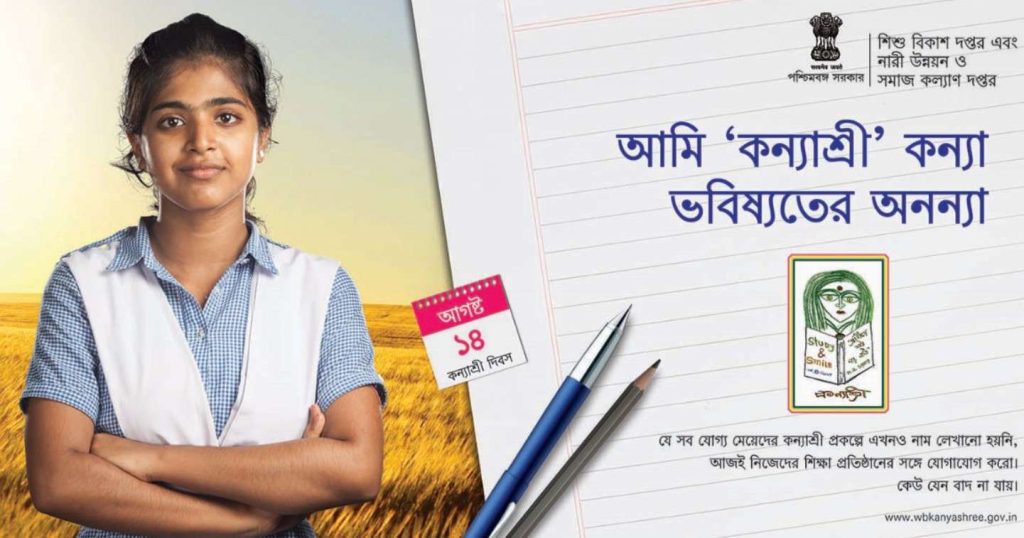
Kanyashree Prakalpa (কন্যাশ্রী প্রকাল্প)
Kanyashree Prakalpa is a Conditional Cash Transfer (CCT) scheme implemented by the Women Development & Social Welfare Department, Government of West Bengal. It was launched on 8 March 2013 with the aim of promoting girls’ education, preventing child marriage, and ensuring greater social protection and empowerment of girls.
Official Taglines
- “Say No to Child Marriage, Yes to Education”
(Bengali: “শিশুবিবাহকে না বলুন, শিক্ষাকে হ্যাঁ বলুন”) - “Girls are the assets of our homes… Let them stand on their own feet. Kanyashree is their inspiration.” — Mamata Banerjee
- “Join Kanyashree, study, learn, and move forward.” — Department of Child Development & Women Development and Social Welfare
- “I am progress, I am Kanyashree.”
Objectives
- Encourage girls aged 13–18 to continue their education
- Prevent early/child marriage (legal minimum age is 18 years)
- Extend girls’ years of schooling and help reduce maternal and child mortality
- Promote social and economic self-reliance of girls and reduce dropouts due to poverty
Benefits (Components of the Scheme)
| Component | Age & Eligibility | Financial Benefit |
|---|---|---|
| Annual Scholarship (K1) | Girls aged 13–18 studying in Classes VIII–XII (including vocational/technical/sports training), unmarried, with family income ≤ ₹1,20,000 per year | Annual scholarship (earlier ₹500; later increased to ₹1,000 in applicable cases) |
| One-Time Grant (K2) | Girl turns 18 (18–19), unmarried, continues education/ vocational/sports training/college or is under JJ Home, and meets income criteria | One-time grant of ₹25,000 |
Nirmal Bangla Mission (নির্মল বাংলা প্রকল্প)
What is the Nirmal Bangla Mission?
The Nirmal Bangla Mission is a rural sanitation and hygiene programme of the Government of West Bengal, which is the state-level version of the Swachh Bharat Mission (Gramin).
Its main objective is to make the state Open Defecation Free (ODF) and to improve sanitation facilities in schools, anganwadi centres, panchayats, and rural areas.
On 30 April 2015, West Bengal declared its first ODF block, starting with Nadia district.
Amount Allotment in Schools
Under the Nirmal Bangla Mission, separate funds are allocated to ensure proper sanitation and a healthy environment in schools. This funding usually comes through joint participation of the Central and State Governments.
Types of Allotment (as per SBM-G / Nirmal Bangla Guidelines)
1. School Toilet Construction / Renovation
- Separate toilet complexes for boys and girls in each school
- Average allocation of ₹30,000 – ₹50,000 for general renovation
- For new toilet complexes, funding can be ₹1,50,000 or more
2. Girls’ Toilets (Special Focus)
- Separate funds for installing sanitary napkin vending machines
- Disposal units for menstrual waste management
3. Drinking Water and Handwash Stations
- Additional funds for handwashing facilities, water storage tanks, and pipelines
- Allocation ranges from ₹20,000 – ₹40,000, depending on school size
4. Awareness & IEC (Information, Education, Communication)
- Funds for hygiene education, posters, campaigns, and awareness activities in schools
- Usually 5%–8% of the total project cost
Sources of Funds
- Central Government (SBM-G): 60% of the total cost
- State Government (Nirmal Bangla): Remaining 40%
- In some cases, additional funds are provided through CSR or DMF (District Mineral Fund)
Practical Impact on Schools
- Almost every government school now has separate toilets for boys and girls
- Student attendance has increased, especially girls’ attendance, due to improved toilet facilities
- Health, hygiene, and cleanliness habits are developing among children
The Nirmal Bangla Mission is not limited to building toilets; it is closely linked with health, dignity, and education. Its effective implementation in schools has ensured a safe, hygienic, and inclusive learning environment for students.
Sabooj Sathi Scheme (সবুজ সাথী প্রকল্প)
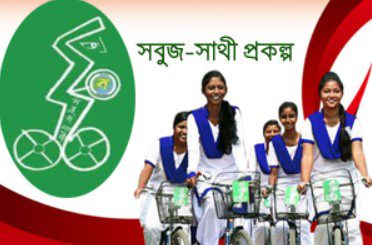
Sabooj Sathi is a flagship scheme of the Government of West Bengal, launched in 2015 by Chief Minister Mamata Banerjee.
Main Objectives
- To provide one free bicycle to every student from Class IX to Class XII studying in government and government-aided schools
- To make school access easier, especially for students from rural and remote areas
- To increase attendance and continuity of education, particularly among girls
- To promote environment-friendly transport (green mobility)
Goals and Benefits
- Equal opportunity in education: Free bicycles for both boys and girls
- Reduction in school dropouts: Minimizes dropout due to long walking distances
- Girls’ empowerment: Improves regular school attendance among girls
- Eco-friendly outlook: Cycling helps reduce pollution
- Rural development: Social and economic empowerment of rural adolescents
Implementation
- Implemented by the Transport Department, Government of West Bengal
- Since 2015, over one crore bicycles have been distributed (up to 2023)
- One of the largest bicycle distribution programmes in the world
Eligibility
- Students of government, government-aided schools and madrasas in West Bengal
- All students of Class IX, X, XI, and XII
Features of the Bicycle
- Strong and durable frame
- Chain cover and carrier
- Printed with the school name and “Sabooj Sathi” logo
- Unique ID-based distribution for each student
“Education will go on, with the bicycle as support – Sabooj Sathi is our hope.”
Shikshashree Scheme (শিক্ষাশ্রী প্রকল্প)
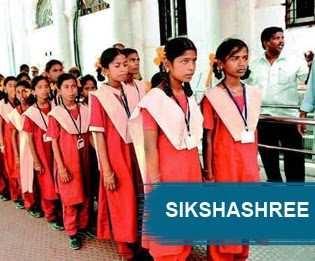
Shikshashree was originally introduced by the Government of Tamil Nadu. In West Bengal, a similar concept has been incorporated under education assistance schemes to support students from Scheduled Caste (SC) and Scheduled Tribe (ST) communities. To be eligible, the annual family income must be within ₹2.5 lakh.
Objectives
- To provide financial assistance to students from economically weaker families so they can continue their education
- To prevent school dropouts
- To ensure equal access to education
Target Beneficiaries
- Primarily SC and other deprived category students
- Students studying in government and government-aided schools
- Specially implemented for students from Class V to Class VIII
Key Benefits
- Scholarship support: A fixed amount is transferred directly to the student’s bank account through Direct Benefit Transfer (DBT)
- Free textbooks, notebooks, uniforms, and study materials
- Ensures continuity of education through financial support
- Reduces the financial burden on families
Scholarship Amount:
- Class VII: ₹750 per year
- Class VIII: ₹800 per year
Implementation
- The scheme is implemented through the e-Scholarship Portal
- Students can apply online, and the scholarship amount is credited directly to their bank accounts
Impact
- The tendency to drop out of school due to financial constraints has reduced significantly
- Students from backward and marginalized communities are receiving equal educational opportunities
- The scheme has contributed to improving the literacy rate
Yuvasree Scheme (যুবশ্রী প্রকল্প)
The Yuvasree Scheme is an economic assistance and employment-oriented initiative of the Government of West Bengal, launched mainly for unemployed youth. It was implemented on 1 October 2013 under the initiative of Mamata Banerjee.
Main Objectives
- To provide financial support to educated unemployed youth
- To help them prepare for jobs or start small businesses
- To enhance employment opportunities and skill development
Benefits
- Monthly Allowance (Unemployment Assistance):
Selected educated unemployed youths receive ₹1,500 per month. - Registration Facility:
Applicants must register with the Employment Bank. After approval, the allowance is granted. - Skill Development:
Along with financial support, beneficiaries receive skill development training to improve employability.
Eligibility
- Must be a permanent resident of West Bengal
- Age limit: Generally 18 to 45 years
- Minimum qualification: Madhyamik / Higher Secondary / Graduation (as applicable)
- Must not have a government job or regular income
- Must be registered with the Employment Bank
Application Process
- Online registration on the Employment Bank portal
- Upload required documents (Aadhaar, educational certificates, bank details, etc.)
- After approval, the allowance is credited directly to the bank account via DBT (Direct Benefit Transfer)
Impact of the Scheme
- Lakhs of youths across the state have benefited
- Supports both financial stability and skill enhancement
- Plays an effective role in addressing unemployment
West Bengal runs many schemes, but here we have discussed those closely linked to education and those frequently asked in interviews. If you need information on more such schemes, please leave a comment. To stay connected, join our WhatsApp channel.
Read More:
- Children With Special Educational Needs
- Common Full Forms of Educational Abbreviations
- Storytelling in the Classroom as a Teaching Strategy
- [HOTs] Primary Teacher Interview Questions and Answers
- Upper Primary Level Teacher Interview Questions and Answers [ V-VIII]
- Secondary Level Teacher Interview Questions and Answers [ IX-X]
- Higher Secondary Level Teacher Interview Questions and Answers [ XI-XII]
- West Bengal Government Important Schemes: Complete Guide for Exams & Interviews
- West Bengal Government Important Schemes 2025 – Education, Welfare & Employment
- West Bengal Government Important Schemes You Must Know for Competitive Exams