
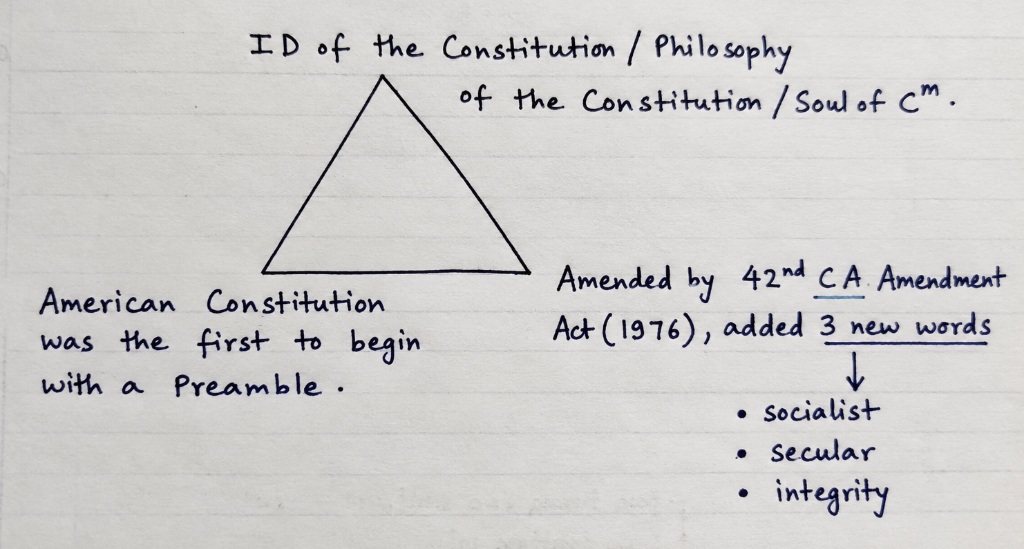
Note:- The word ‘Preamble’ means Preface of the Constitution. It is not only a part of the Constitution, it also is an essence of the Constitution. Pandit Nehru drafted the ‘Objective Resolution’ on which the Preamble is based.
WE, THE PEOPLE OF INDIA, having solemnly resolved to constitute India into a SOVEREIGN SOCIALIST SECULAR DEMOCRATIC REPUBLIC and to secure all its citizens:
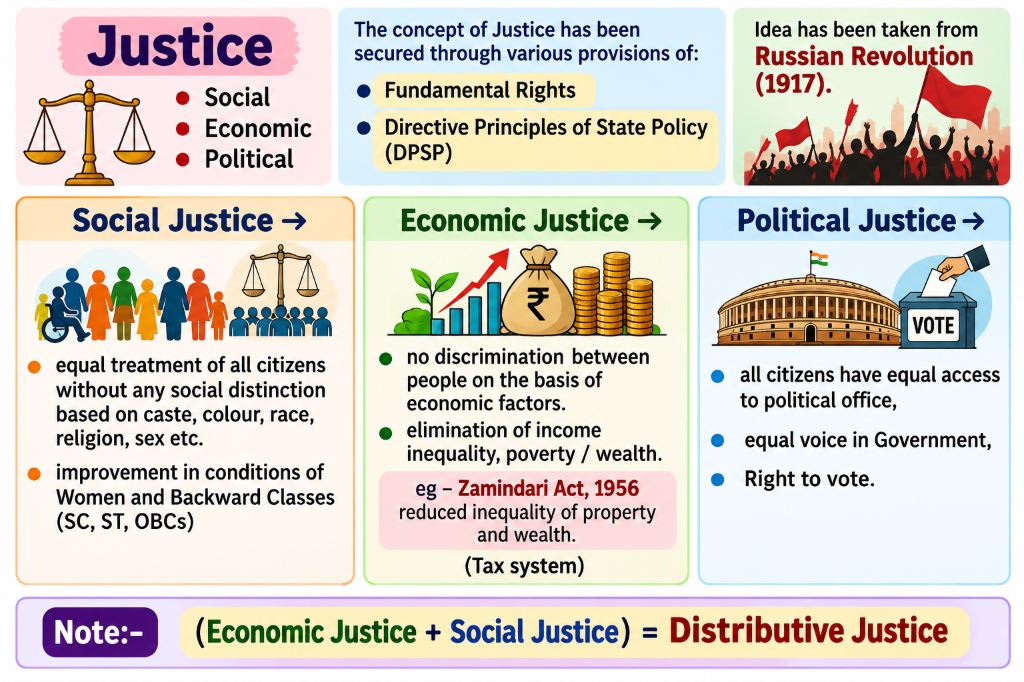
JUSTICE, Social, Economic and Political;
LIBERTY of thought, expression, belief, faith and worship;
EQUALITY of status and of opportunity
and to promote among them all;
FRATERNITY assuring the dignity of the Individual
and unity and integrity of the nation.
IN OUR CONSTITUENT ASSEMBLY this twenty-sixth day of November, 1949, do HEREBY ADOPT, ENACT AND GIVE TO OURSELVES THIS CONSTITUTION
What does the Preamble reveals?
Source of Authority → The Preamble derives its authority from people of India.
Objective of CONSTITUENT
- Justice
- Liberty
- Equality
- Fraternity
Nature of Indian State
- Sovereign
- Socialist
- Secular
- Democratic
- Republic
Key words in the Preamble → (Nabaratra)
- Sovereign
- Socialist
- Secular
- Democratic
- Republic
- Justice
- Liberty
- Equality
- Fraternity
Objectives of Indian Constitution
1) Sovereign
India is an ‘independent’ state, neither a dependency nor a dominion of any other state.
It is free to conduct its affairs both internal and external.
Can acquire a foreign territory or cede part of its territory from a foreign state.
- internal → free govt. which is directly elected by the people and makes laws that govern the people.
- external → free from control of any foreign power which can dictate the govt.
- Hence Govt. also enjoy sovereign power to elect their representatives in election held for parliament, S.L. and L.R. as well.
Note:- India’s membership at UNO, or Commonwealth doesn’t affect India’s sovereignty in any manner.
2) Socialist
Democratic (non-communalist) socialism: Aims to end poverty, ignorance, disease and inequality of opportunity
- (1) The term socialist was added in 42nd Amendment Act, 1976.
- (2) Indian Socialism is called ‘Democratic Socialism’
- (3) India adopted socialist content from DPSP – Directive Principles of State Policy
Aims
to end:
- poverty
- ignorance
- disease
- inequality of opportunity
Mixed Economy (have both public and private sector co-exist)
Note:- Democratic Socialism (Mixed Economy) is completely different from Communist Socialism / State Socialism (Socialistic Economy).
In State Socialism, the Govt. has complete ownership of all means of production and there is no existence of any private ownership.
Eg – USSR.
Note:- Indian socialism is a perfect blend of State socialism and Gandhian socialism, leaning heavily towards Gandhian socialism. The New Economic policy (1991) of liberalization, privatization, globalization diluted its socialistic credentials of Indian state.
↓
“Policy is the Guardian of Economy”
3) Secular
- The term Secular was added in 42nd Amendment Act, 1976.
- Fundamental Right: Articles 25–28
→ Guaranteeing Freedom of Religion - Indian Secularism means →
all religion in the country (irrespective of their strength) have the same status and support from State.
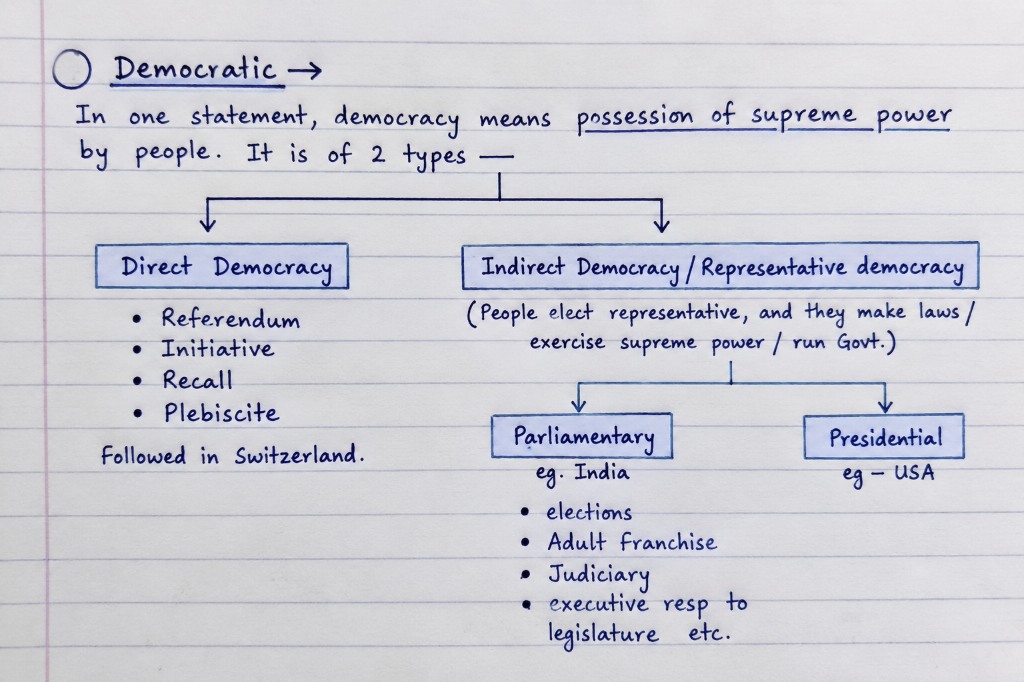
4. Democratic
5. Republic
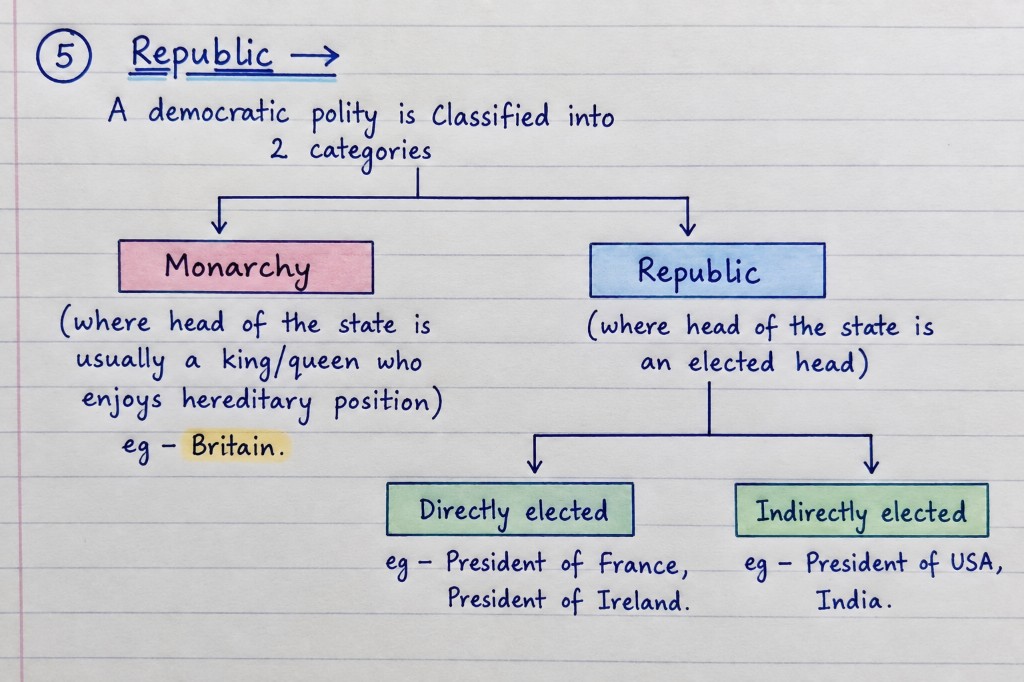
Note: The term Republic also means two more things:
- Political sovereignty → refers to highest level of absolute power through which independent states are controlled by a designated political authority.
- Absence of any Privileged class → public offices being opened to every citizen without discrimination.
6. Justice
7. Liberty
- Liberty of thought, expression, belief, faith and worship.
- The concept of Liberty, Equality, Fraternity → French Revolution.
- Guaranteed by Fundamental Rights.
Note:- Liberty conceived by Preamble as FR is qualified not absolute. It means that, Liberty doesn’t mean license to do what one likes.
8) Equality
The term Equality means absence of special privileges to any section of the society. The Preamble secures the concept of equality in 3 dimensions of △
- Civic
- Political
- Economic
Civic Equality
- Article 14 → Equality before the law.
- Article 15 → Prohibition of discrimination on grounds of religion, race, caste, sex, place of birth etc.
- Article 16 → Equality of opportunity in matters of public employment.
- Article 17 → Abolition of untouchability.
- Article 18 → Abolition of Titles.
Political Equality
- Article 325 → No person is to be declared ineligible for inclusion in electoral rolls on grounds of religion.
- Article 326 → Elections to Lok Sabha and State Assemblies to be on the basis of Adult Suffrage.
Economic Equality
- Article 39 → Secures to men and women equal right to an adequate means of livelihood and equal pay for equal work.
9. Fraternity
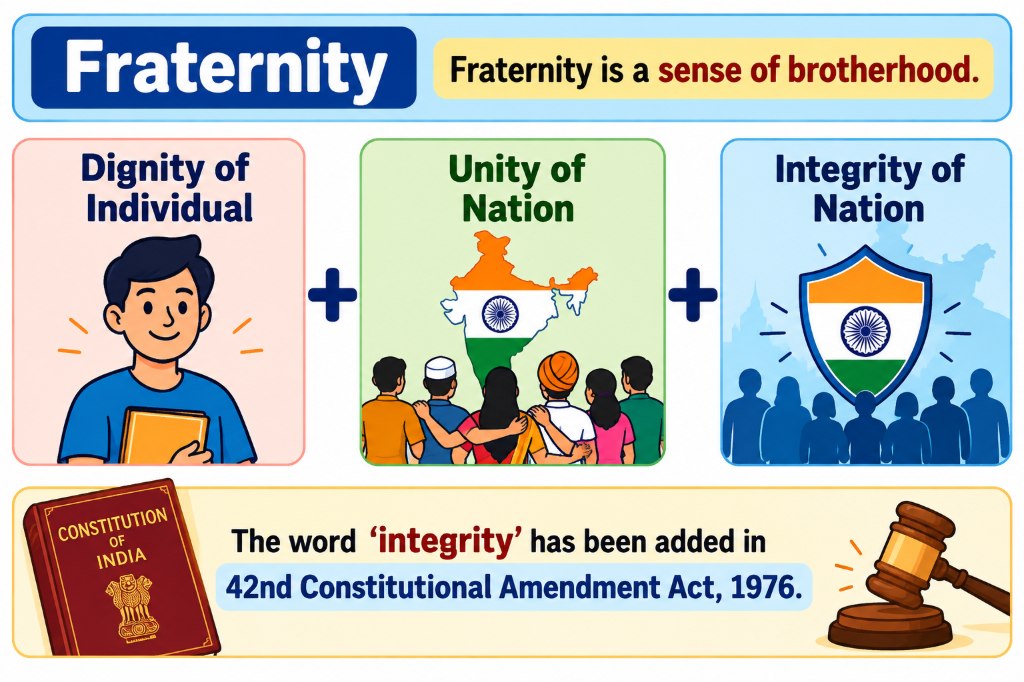
The concept of brotherhood has been upheld by-
- single citizenship
Fundamental duty Article 51-A
- shall be the duty of every citizen of India to promote harmony and spirit of common brotherhood among people of India transcending religious, linguistic, regional, sectional diversity etc.
Constitution condemns activities like –
- Communalism
- Regionalism
- Casteism
- Linguism etc.
Note:- Moreover, the concept of Fraternity promotes unity and integrity of nation but also psychological and territorial dimensions of National Integration.
↓
So, it states India is a Union of states, no state has the right to get separated from Indian Union.
Riots, movements for separate state → Khalistan, Regionalism etc. – Such problems will continue till the concept of Fraternity has been properly understood and implemented in life.
Significance of the Preamble
The Preamble embodies political, moral and religious philosophy on which Constitution is based. Few comments of Great personalities would illuminate the significance of the Preamble:
(a) “The Preamble to our Constitution expresses what we thought or dreamt so long” – A.K. Iyer (Mem. of Constituent Assembly)
(b) “Horoscope of our sovereign democratic Republic.” – K. M. Munshi (Mem. of Constituent Assembly)
(c) “Key-note to the Constitution” → Ernest Barker (Political scientist)
(d) “Soul of our constitution that lays down the pattern of our political society” → M. Hidayatullah (former CJI)
Preamble as Part of the Constitution
Supreme Court rulings in various judgements regarding Preamble →
Berubari Union Case (1960) →
Supreme Court ruled that Preamble is a key to the minds of makers of the Constitution.
It provides assistance in the interpretation of the Constitution through its key objectives. But it is not a part of the Constitution.
Keshavananda Bharati Case (1973) →
Supreme Court ruled that Preamble is of extreme importance and the Constitution should be interpreted in the light of it.
It declared that Preamble is a part of the Constitution.
LIC of India Case (1995) →
Supreme Court ruled that Preamble is an integral part of the Constitution.
↓
So, Finally Preamble is considered as an integral part of constitution.
All the controversies regarding whether Preamble is part or not a part of Constitution came to an end. But it is to be noted that: Preamble is non-justiciable in nature & not a prohibition on powers of legislature.
Amendability of the Preamble
Earlier Supreme Court stated that Preamble is not a part of the Constitution so it can’t be amended.
Later in K.C. Bhargava Case (1973) Supreme Court stated that Preamble is an integral part of the Constitution, and so, it can be amended but no amendment can be done to its ‘basic features’.
↓
Fundamental features of the Constitution contained in the Preamble.
Preamble can be amended except the basic features. Article 368 Contains Amendability of Preamble.
Only once the Preamble has been amended: 42nd Constitutional Amendment Act added 3 new words
- Socialist
- Secular
- Integrity
